
Up flow Anaerobic Sludge Blanket Process
Anaerobic treatment is widely used around the world as a biological stage in both domestic and industrial wastewater-treatment plants. The two main advantages of Kelvin’s anaerobic treatment are the production of biogas, which can be used as fuel, and the lower rate of biomass production as sludge produced is only 5-10% also reducing cost of sludge disposal, which results in lower maintenance costs for the plan. Also this system uses biology, thus without using air or oxygen the anaerobic microorganisms convert organic pollutants into a “biogas” which contains methane and carbon dioxide.
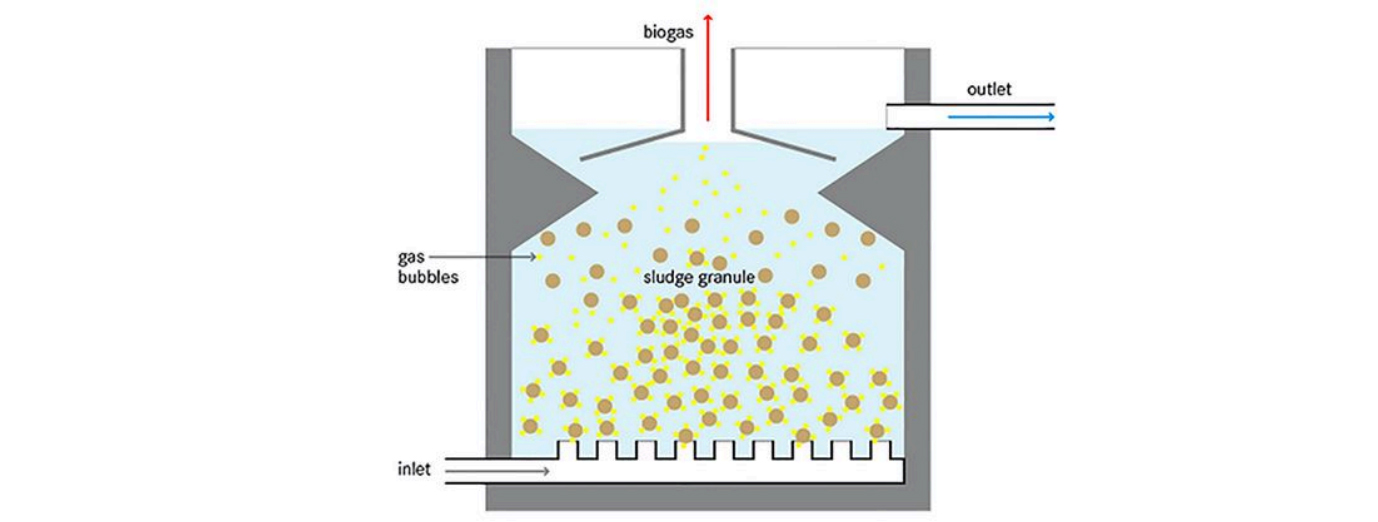
The above diagram shows the simplified version of Kelvin’s UASB.
The sludge blanket is comprised of microbial granules (1 to 3 mm in diameter). The microorganisms in the sludge layer
degrade organic compounds. Because of the up flow regime, granule-forming organisms are preferentially
accumulated as the others are washed out.
After several weeks of use, larger granules of sludge form which, in turn, act as filters for smaller particles as the
effluent rises through the cushion of sludge. Coming in contact with the granules the treatment occurs.
The gas thus released is methane and carbon dioxide, and this needs no mechanical assistance. The sloped walls of
Kelvin’s USAB deflects the rising material downwards, and only the clarified or treated effluent goes out via outlet at
the top.